Personal Loans in India: What You Should Know Before Taking One

A personal loan can be useful when you need a fairly large amount of money and don’t want to put your home or car up as security.
Maybe there’s an unexpected medical bill. Maybe you’re planning a wedding, doing some work around the house, or dealing with an expense that you didn’t see coming.
Getting the loan itself may not be the difficult part.
The more important question is whether you can comfortably pay it back.
What is a personal loan?
A personal loan is usually an unsecured loan. That means you don’t normally have to offer an asset such as a house or car as collateral.
The lender looks at your financial profile instead. Your income, credit history, existing EMIs, employment and repayment record can all play a part in the decision.
Once approved, the money is deposited into your account and you repay it through monthly EMIs.
The exact interest rate and loan amount you receive will depend on the lender and your profile.
Don’t look only at the interest rate
This is probably the easiest mistake to make.
You see one lender offering a lower interest rate than another and assume you’ve found the cheaper loan.
Not necessarily.
There can be a processing fee, taxes and other charges. Some loans may also have charges related to prepayment or foreclosure.
So when comparing two personal loans, look at the total amount you will have to repay, not just the rate shown in the advertisement.
For example, if you borrow ₹3 lakh, you already know that you will have to return more than ₹3 lakh when interest and applicable charges are included.
The actual number is what you should compare.
How much should you borrow?
Just because a bank is willing to lend you ₹8 lakh doesn’t mean you need to borrow ₹8 lakh.
Work backwards from your requirement.
If you need ₹2 lakh, taking ₹5 lakh simply because the larger amount is available means you’ll be paying interest on money you didn’t actually need.
Your monthly budget matters too.
Imagine you already pay ₹15,000 every month toward existing loans. Adding another ₹10,000 EMI might look manageable on paper, but you still have rent, food, bills, savings and everything else to deal with.
A loan should fit into your life. Your life shouldn’t have to revolve around the EMI.
What happens to the EMI if you choose a longer tenure?
A longer tenure generally means a smaller EMI.
That can be helpful if your monthly budget is tight.
But there is another side to it. You keep the loan for longer, so the total interest you pay can be higher.
A shorter tenure can save interest, but the monthly payment will usually be higher.
There isn’t one perfect tenure for everyone. The sensible choice is the one that gives you a manageable EMI without stretching the loan unnecessarily.
Your credit history matters
Before approving a personal loan, lenders can look at your credit history and other financial details.
A good repayment record can help. If you’ve regularly paid your previous loans and credit-card bills on time, that’s generally a positive sign.
Your income and existing debt matter as well.
It’s worth checking your credit report before applying, especially if you haven’t looked at it for a while. You may find an error that needs to be corrected.
And don’t apply for a large number of loans just because you’re curious about which lender will approve you.
When does a personal loan make sense?
It depends on the situation.
If you have a genuine financial need and enough income to comfortably handle the repayment, a personal loan can be a practical option.
It can also be useful when you need to deal with an unexpected expense and don’t have enough savings available.
Debt consolidation is another situation where people sometimes use personal loans. If you have several expensive debts, replacing them with a loan that has a lower overall cost could make things easier.
But check the numbers before doing this. A new loan doesn’t automatically make old debt cheaper.
When should you think twice?
I’d be much more careful about borrowing for things that can wait.
Buying the latest phone is one example.
Taking a personal loan for a holiday is another.
There’s nothing wrong with spending money on these things if you can afford them. The problem is when the only reason they seem affordable is because you’re looking at the monthly EMI instead of the full cost.
₹3,000 a month doesn’t sound like much.
But ₹3,000 coming out of your account every month for several years is a different story.
And if you’re taking a new loan to pay your normal household bills, that’s an even bigger warning sign. It may be better to look at the underlying cash-flow problem before adding another EMI.
Personal loan or credit-card EMI?
There isn’t a universal winner.
A personal loan gives you a fixed amount and a repayment schedule.
A credit card may allow you to convert certain purchases into EMIs, depending on the card and the transaction.
Compare the actual offers available to you.
Check the interest rate, processing fee, tenure and total repayment amount.
Don’t choose one simply because someone says personal loans are always cheaper or credit-card EMIs are always expensive. The numbers can vary from one offer to another.
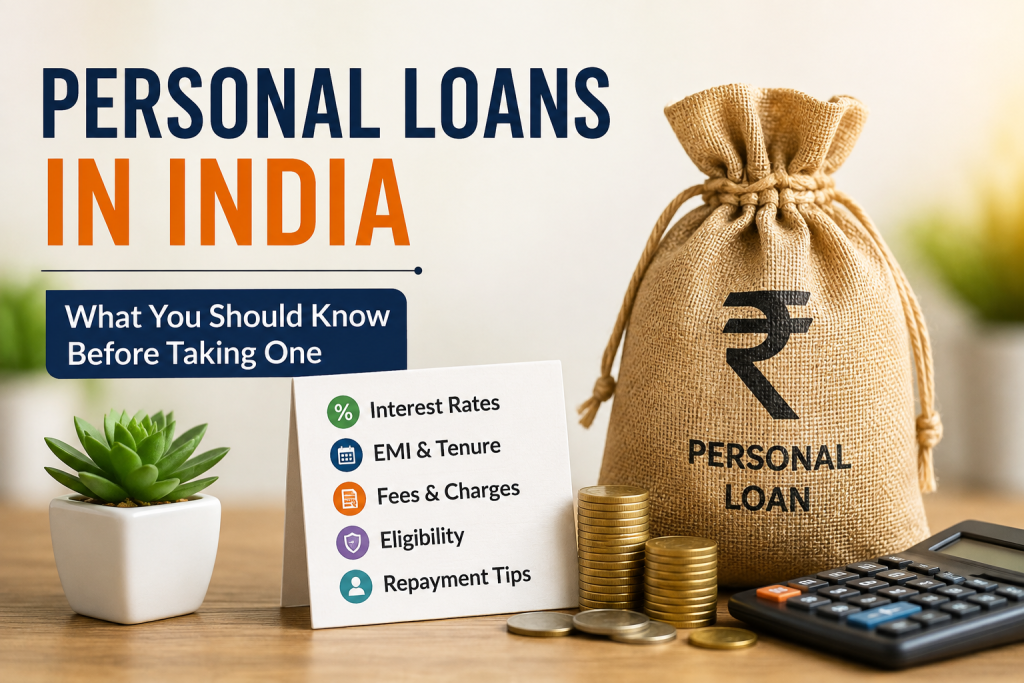
What should you check before accepting the loan?
Before clicking the final “accept” button, check the important details.
Look at:
- Loan amount
- Interest rate
- EMI
- Loan tenure
- Processing fee
- Applicable taxes and charges
- Prepayment or foreclosure rules
- Late-payment charges
- Total amount payable
If there’s something in the loan agreement you don’t understand, ask the lender about it before accepting the offer.
It is much easier to clear up a question before taking the loan than after the money has already been deposited.
The simple way to look at a personal loan
A personal loan isn’t automatically a bad financial decision.
It can be useful when you have a genuine need, know exactly how much you need and have enough income to make the repayments without constantly worrying about the next EMI.
But borrowing should not become a way of making an unaffordable purchase look affordable.
Before taking the loan, calculate what it will actually cost you.
Then look at your monthly budget.
If the numbers work comfortably, you can consider it.
If the EMI is going to make every month feel tight, borrowing less—or waiting until you can afford the expense—may be the better decision.