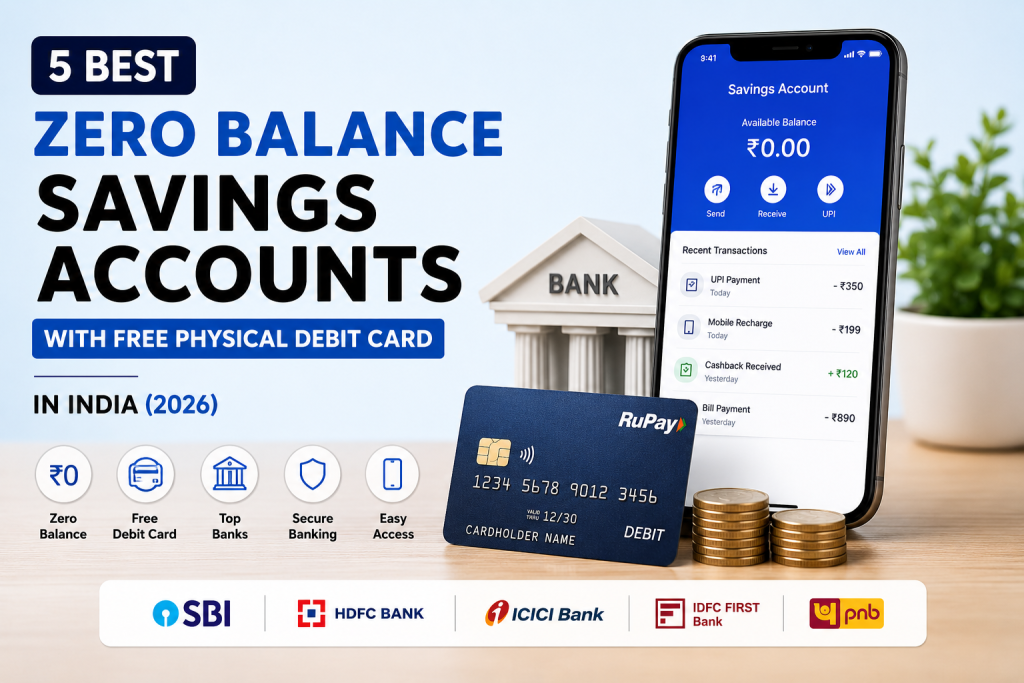
5 Zero Balance Savings Accounts with Free Physical Debit Card in India (2026)

Not everyone wants to keep ₹5,000 or ₹10,000 in a savings account just because the bank says so.
Maybe you’re a student. Maybe you’re opening your first bank account. Or maybe you simply want a separate account for UPI and everyday expenses.
In that case, a zero balance savings account can be quite useful.
I also wanted to focus on something else in this list: the physical debit card. Some digital bank accounts give you a virtual card but charge extra if you want the physical one.
The five accounts below have a zero-balance/basic savings option and a physical debit-card facility. But there is an important difference between free card issuance and free card forever. I’ll explain that for each bank instead of simply calling everything “free.”
Quick look at the 5 accounts
| Bank | Account | Minimum Balance | Physical Debit Card | Online Opening |
| SBI | Basic Savings Bank Deposit Account | ₹0 | Free basic RuPay card | Digital facilities available; check current onboarding route |
| HDFC Bank | BSBDA | ₹0 | Free RuPay card | Depends on application route |
| ICICI Bank | BSBDA / PMJDY | ₹0 | Complimentary RuPay card | Check current availability |
| IDFC FIRST Bank | Pratham BSBDA | ₹0 | RuPay Classic | Branch availability for Pratham |
| PNB | BSBDA | ₹0 | ATM/debit card facility without issuance charge | Usually branch-based |
One thing to notice here: zero balance doesn’t automatically mean every service is free. ATM limits, annual card charges and other service charges can still apply.
1. SBI Basic Savings Bank Deposit Account
Let’s start with SBI because it’s probably the easiest name on this list to recognise.
SBI’s Basic Savings Bank Deposit Account (BSBD) has no minimum balance requirement. The bank also says the basic RuPay ATM-cum-debit card is issued free of cost and doesn’t have an annual maintenance charge.
So if your main concern is:
“I don’t want to maintain ₹5,000 or ₹10,000 in my account.”
SBI’s BSBD account is worth looking at.
What do you get?
You get the basic things you’d expect from a savings account:
- UPI and digital banking
- ATM/debit card
- Deposits and withdrawals
- Fund transfers
- Passbook
- No minimum balance requirement
SBI currently allows at least four free withdrawals a month, including ATM withdrawals. Digital payment transactions such as UPI, NEFT, RTGS and IMPS aren’t counted as withdrawals for this particular limit.
That’s useful if you mostly use UPI and don’t regularly take out cash.
How do you open it?
You can check SBI’s current online options through YONO SBI or the bank’s website. SBI also makes the BSBD account available through its branches.
If you go to a branch, simply ask for a Basic Savings Bank Deposit Account.
That’s important because SBI also has regular savings accounts, and those can have different requirements.
One thing to remember
You generally can’t keep another BSBD account with another bank. SBI’s current terms also say a person with a BSBD account isn’t eligible to open another BSBD account.
So don’t open multiple basic accounts just because they’re zero balance.
2. HDFC Bank Basic Savings Bank Deposit Account
If you’d rather use a private bank, HDFC Bank has its own Basic Savings Bank Deposit Account.
The account has a nil minimum balance requirement and comes with a free RuPay debit card according to HDFC Bank’s current product information.
You also get access to basic digital banking services such as NetBanking and mobile banking.
What makes it useful?
It’s a fairly straightforward account.
You don’t have to keep a particular amount sitting in the account every month, and you still get the normal facilities you’d expect from a large private bank.
HDFC currently lists up to four debit-card transactions per month across the applicable modes as part of its BSBDA features.
There’s a small catch
HDFC’s BSBDA has a restriction that many people don’t notice.
If you have this account, you can’t keep another savings account with HDFC Bank in your primary capacity.
So if you already have an HDFC savings account, check the bank’s rules before deciding to switch.
Who should consider it?
Someone who wants a basic account with a private bank and doesn’t want to worry about minimum-balance requirements.
3. ICICI Bank Basic Savings Bank Deposit Account
ICICI Bank’s BSBDA is another option worth considering.
The bank says there is no minimum monthly average balance requirement. It also provides a RuPay debit card, and under its PMJDY offering, ICICI lists a complimentary personalised RuPay debit card.
This is basically the kind of account you’d look at if you want banking to stay simple.
What can you use it for?
You can use the account for normal banking activities such as:
- UPI
- Mobile banking
- NetBanking
- ATM withdrawals
- Deposits
- Fund transfers
The account can also be held singly or jointly, according to ICICI’s current information.
What about the debit card?
This is one of the better parts if you’re specifically looking for a physical card.
ICICI’s PMJDY/BSBDA information says the personalised RuPay debit card is complimentary.
Still, I’d check the current schedule of charges before applying. A complimentary card doesn’t mean every future card-related service is free.
Who is it for?
I’d say this one makes sense if you already use ICICI Bank or simply prefer its banking app and services.
If you’re opening your first account, it’s also worth comparing it with SBI and HDFC before making a decision.
4. IDFC FIRST Bank Pratham Savings Account
This one is a little different.
IDFC FIRST Bank calls its zero-balance BSBDA offering the Pratham Savings Account.
The bank currently lists:
- Zero balance requirement
- RuPay Classic debit card
- Monthly interest credit
- Basic banking facilities
- Micro-ATM access
The bank’s current fee schedule lists nil debit-card issuance charges and nil annual charges for the Pratham BSBDA account.
That’s a pretty good combination if you’re looking for a basic account without regular balance requirements.
The interest is worth mentioning
IDFC FIRST Bank currently advertises interest of up to 6.50% per year on its zero-balance savings account, with interest credited monthly.
But don’t read that as “you will definitely get 6.50%.”
Savings-account interest depends on the applicable balance slab and current bank rates. So check the rate that applies to the amount you actually plan to keep in the account.
Can you open Pratham online?
This is where you should pay attention.
IDFC FIRST Bank’s current page shows online account opening for savings accounts, but the Pratham BSBDA is also shown with a “Visit Nearest Branch” route.
So if your only requirement is:
“I want a zero-balance account that I can open completely online.”
Don’t assume Pratham will meet that requirement. Check the current availability in your location before applying.
5. PNB Basic Savings Bank Deposit Account
PNB also has a Basic Savings Bank Deposit Account, which it describes as a zero-balance account.
The minimum balance is ₹0, and PNB says an ATM or ATM-cum-debit card is available without an issuance charge.
This is another good option if you prefer a public-sector bank.
What about the card?
There’s an important detail here.
PNB’s current information says the card can be issued without a charge, but an annual maintenance charge may still apply depending on the card/account terms.
So I wouldn’t describe this as “completely free debit card forever.”
The better way to look at it is:
Free card issuance, but check the current annual card charge.
That’s exactly the kind of detail you should look for before opening any bank account.
ATM withdrawals
PNB’s BSBDA information provides a minimum of six free withdrawals per month, including ATM withdrawals.
That can be useful if you still use cash regularly.
What Does “Zero Balance” Actually Mean?
This part is easy to misunderstand.
A zero-balance account doesn’t mean the bank will never charge you anything.
It simply means you don’t have to maintain a minimum balance to avoid a non-maintenance charge.
For example, imagine you have ₹800 in your account.
With a normal account that requires ₹10,000, you might have a minimum-balance issue.
With a zero-balance account, that isn’t the problem.
You can keep ₹800, ₹100 or even ₹0 without worrying about a minimum-balance penalty, as long as you follow the account’s other rules.
Is the Physical Debit Card Really Free?
This is probably the most important part of this article.
There are three different things banks can mean:
Free card issuance
You don’t pay when the card is issued.
Free annual maintenance
You don’t pay an annual card fee.
Free replacement
You don’t pay if you need another card after losing or damaging the original.
These are not the same thing.
For example, SBI currently says its basic RuPay card is issued free and has no annual maintenance charge.
PNB, on the other hand, says its BSBDA card can be issued without charge but also notes that annual maintenance charges can apply.
That’s why I wouldn’t choose a bank just because you see the word “free” on the account page.
Which One Is Best?
It depends on what you actually need.
If you want a large branch network
SBI is a practical choice.
If you prefer a private bank
Look at HDFC Bank or ICICI Bank.
If savings interest matters to you
IDFC FIRST Bank Pratham is worth checking, especially because the bank currently advertises monthly interest credit and a competitive savings rate.
If you prefer a public-sector bank other than SBI
PNB is another option.
I wouldn’t say one of these is automatically the “best” for everyone.
Your nearest branch, ATM availability, mobile app, UPI experience and card charges can matter much more than a small difference in interest.
What Documents Do You Need?
The KYC process is normally quite straightforward.
Keep these ready:
- PAN card
- Aadhaar card
- Mobile number
- Address details
- Photograph, if required
The exact documents can vary depending on the bank and how you open the account.
If you’re opening an account online, you may also need to complete Aadhaar OTP verification or Video KYC, depending on the bank’s current process.
Can Students Open These Accounts?
A basic savings account can be useful for students, especially if you’re opening your first account.
You don’t need to keep a large amount of money just to maintain the account.
If you’re 18 or older, check the bank’s eligibility requirements and KYC process. For younger customers, some banks have separate minor account rules.
And if you’re a student, I’d personally pay more attention to ATM availability, UPI, mobile banking and card charges than fancy account benefits that you may never use.
Things I Would Check Before Opening Any Account
Before you apply, take a few minutes and check:
- Minimum balance requirement
- Debit-card issuance fee
- Annual debit-card fee
- ATM withdrawal limit
- Number of free ATM transactions
- Replacement-card charges
- UPI and mobile banking availability
- Online KYC availability
- Whether you can keep another savings account with the same bank
These details can save you from a surprise charge later.
Final Thoughts
A zero-balance savings account is useful for a very simple reason: you don’t have to keep a fixed amount of money sitting in the account.
If you’re opening your first account or just want a separate account for everyday payments, it’s worth considering.
SBI, HDFC Bank, ICICI Bank, IDFC FIRST Bank and PNB all have basic/zero-balance options worth looking at, but the details aren’t exactly the same.
And don’t take the word “free” too literally.
Before opening the account, check the latest card charges, ATM rules and KYC process on the bank’s official website. Banks can change their fees and account features, so it’s always better to check the current terms rather than relying on an old article.
That’s especially important when you’re choosing a bank account you’ll probably use for years.