How Students Can Get an Unsecured Credit Card in India?

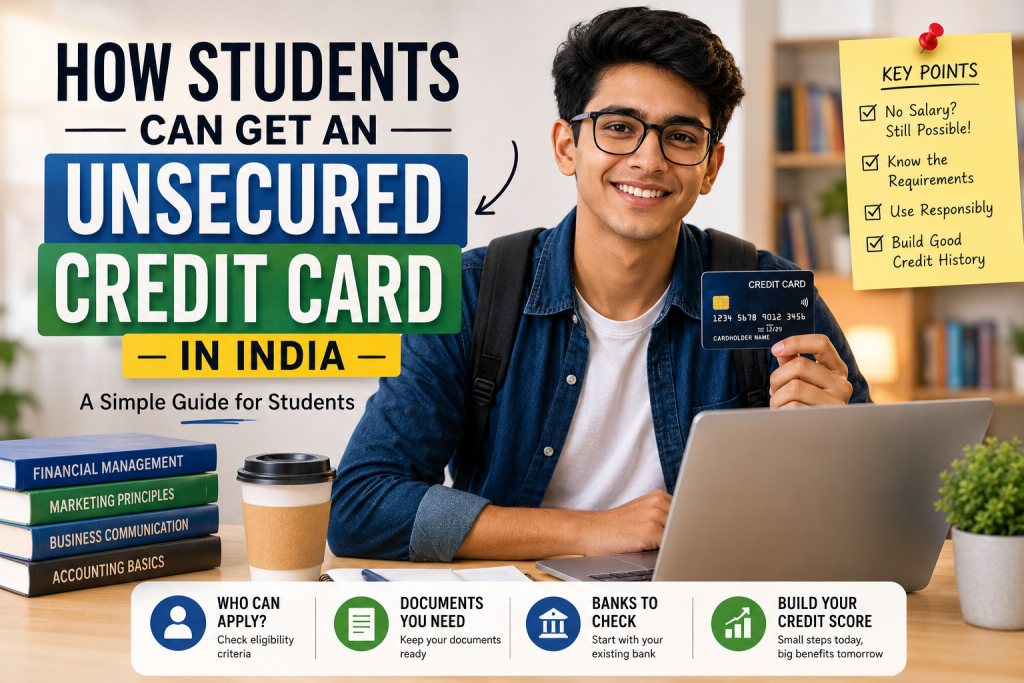
Getting your first credit card as a student sounds easy until you actually try applying for one.
You fill in your details, select a card you like and then suddenly the bank asks about your salary, employer, income proof and credit history.
And you’re sitting there thinking:
“I’m a student. I don’t have a salary. So how am I supposed to get a credit card?”
That’s the problem many students face.
The good news is that being a student does not automatically mean you can never get an unsecured credit card. But it can be harder, because banks usually want some proof that you can repay the money you borrow.
And this is where things get a little confusing.
An unsecured credit card doesn’t require you to keep a fixed deposit as security. A normal credit card generally works this way. But approval depends on the bank, the card and your financial profile.
For example, HDFC Bank’s standard credit-card policy currently lists a minimum age of 21 for its standard products and says eligible applicants can be salaried or self-employed, while regular cards don’t require collateral. (HDFC Bank)
So if you’re a college student with no income, getting one of these cards isn’t always easy.
But there are a few things you can try.
First, What Is an Unsecured Credit Card?
Let’s make this very simple.
With a secured credit card, you usually give the bank an FD and the bank gives you a card against it.
With an unsecured credit card, there is no FD sitting behind the card.
The bank is basically saying:
“We think you’re capable of paying us back, so we’ll give you this credit limit.”
That’s why banks normally look at your income, age, credit history and other information before approving the card.
HDFC Bank, for example, states that its regular cards don’t require collateral, while it separately offers FD-based cards. (HDFC Bank)
For a student, the difficult part is proving repayment ability.
Can a Student Get an Unsecured Credit Card?
Yes, but it depends on your situation.
If you’re 18 or 19, have no income and have never used credit before, your options will probably be limited.
If you’re 21+, have a part-time job, internship income, business income or another acceptable source of income, you may have more options.
There is no single rule that says:
“Students cannot get credit cards.”
Banks look at the individual application.
And honestly, I wouldn’t apply for random cards just hoping one of them gets approved.
First find out what you can realistically qualify for.
Having a Bank Account Can Help
One thing I’d try first is checking whether your existing bank is offering you a credit card.
Maybe you’ve had a savings account with the same bank for a few years.
Your bank may already have information about your account activity and may show a card offer inside internet banking or the mobile app.
That doesn’t guarantee approval.
But it’s worth checking before you start applying everywhere.
Sometimes you’ll see something like:
“You’re eligible for this credit card.”
If you see an offer like that, still check the fees and conditions before accepting it.
A pre-approved or pre-qualified offer doesn’t mean you should blindly take the card.
What If I Don’t Have a Salary?
This is probably the biggest question students have.
A salary is one way to show income, but it’s not necessarily the only situation a lender may consider.
The important thing is what the particular bank and card accepts as income.
For some applications, the bank may ask for income documents. HDFC Bank, for example, lists salary slips and Form 16 among documents that can be used as income proof for applicable credit-card applications. (HDFC Bank)
If you’re a student with no income at all, getting a regular unsecured card can therefore be difficult.
That’s where you need to be realistic.
Don’t try to show fake income just to get approved.
It’s not worth it.
What If I Earn Money From Freelancing?
This is a different situation.
Let’s say you’re a student but you do freelance graphic design, coding, video editing, tutoring or some other work.
You may have income even though you’re not working in a traditional full-time job.
The question is whether the bank accepts that type of income and what documents it wants.
You may need things like bank statements, income records or tax-related documents depending on the application.
Don’t assume that because money comes into your bank account every month, the bank will automatically treat it as accepted income.
Check the card’s eligibility rules first.
What About a Part-Time Job?
A part-time job can also change things.
Suppose you’re studying in college and working part-time on the side.
You may have regular income, but the bank will still decide whether that income meets its requirements.
Again, there is no guarantee.
The important thing is that you’re applying based on your actual financial situation.
Not something you made up on the application.
Your Existing Credit History Matters Too
This is another problem for young students.
You may have never taken a loan.
You may have never had a credit card.
You’ve never missed a payment because you’ve never had a payment to make.
That doesn’t mean you have bad credit.
It may simply mean you don’t have much credit history yet.
AllAbtFin has a simple guide on how to build a credit score from zero in India, including why starting with small amounts of credit can make more sense than borrowing a lot of money.
A credit card can eventually help you build a credit history if you use it properly and pay your bills on time.
But getting into debt just to create a CIBIL score isn’t a good idea.
What If the Bank Rejects Your Application?
Don’t take it personally.
A rejection doesn’t mean you’ll never get a credit card.
Maybe you don’t meet the age requirement.
Maybe your income isn’t high enough.
Maybe the bank doesn’t have enough information about you.
Maybe you simply aren’t eligible for that particular card.
It happens.
What I wouldn’t do is immediately apply for another five cards.
That’s usually not a great approach.
Take a look at why you were rejected first.
Then wait and try again when your financial profile is stronger.
Don’t Lie About Your Income
I know this sounds obvious, but it’s worth saying.
If you’re a student earning ₹8,000 a month, don’t put ₹40,000 as your monthly income just because you think the bank will approve you.
Don’t use fake salary slips either.
It’s simply not worth the trouble.
If the bank asks for documents later and the information doesn’t match, you can create a much bigger problem for yourself.
Apply with your real details.
If you don’t qualify today, that’s fine.
You can work on your profile and try later.
Another Option: An Add-On Card
If your parents already have a credit card, you can also ask about an add-on card.
This can be useful if you mainly want the convenience of having a credit card while you’re studying.
But there is an important difference.
An add-on card is connected to the primary cardholder’s account.
So don’t assume that getting an add-on card is exactly the same as having your own primary credit card and building your own credit history.
If building your own credit profile is the main reason you’re getting the card, ask the card issuer how the account will be reported.
That’s something I’d check first.
What About an FD-Backed Card?
If getting an unsecured card isn’t working, an FD-backed card is still worth knowing about.
You put money into a Fixed Deposit.
The bank gives you a credit card against it.
It’s not what this article is mainly about because you’re looking for an unsecured card, but it’s a useful backup option.
AllAbtFin also explains this in its guide to building a credit score from zero.
The nice thing about an FD-backed card is that you don’t have to convince the bank that you have a high salary.
The FD provides security.
But you should still check the card’s fees, limit and FD rules before opening one.
Don’t Chase a Big Credit Limit
This is something I really wouldn’t worry about as a student.
If a bank gives you a ₹20,000 limit, that’s enough.
You don’t need ₹1 lakh.
You don’t need ₹2 lakh.
A higher credit limit doesn’t mean you should spend more.
In fact, when you’re getting your first card, I’d rather have a small limit that I can comfortably manage.
Suppose your card gives you a ₹30,000 limit.
You don’t need to spend ₹30,000 every month.
Maybe you spend ₹4,000 or ₹5,000 on normal expenses and pay the bill completely.
That’s a much healthier way to use the card.
Pay the Full Bill
This is the part I would take seriously.
When your credit-card bill arrives, don’t just look at the Minimum Amount Due and think:
“Great, I only need to pay this much.”
If you can afford to pay the full bill, pay it.
Credit cards can become expensive when you keep carrying balances and paying interest.
You’re a student.
You probably don’t want a small ₹5,000 purchase turning into a much bigger financial headache.
Use the card for things you could already afford.
That’s the easiest rule.
What Kind of Student Has a Better Chance?
There isn’t a guaranteed profile, but generally I’d say your chances are better if you have some combination of:
- You’re old enough for the particular card
- You have regular income
- You have a good banking relationship
- You have an existing credit history
- You have acceptable income documents
- You meet the bank’s specific eligibility requirements
If you have none of these, don’t be surprised if a normal unsecured card application gets rejected.
That doesn’t mean you can’t get one later.
Start With One Card
You don’t need three credit cards while you’re in college.
Seriously.
One card is more than enough when you’re starting.
Use it.
Learn how the billing cycle works.
Learn what the due date means.
Understand your credit limit.
Pay the bill.
After some time, you’ll know whether you even need another card.
I’ve also written about how many credit cards you should have in India if you’re thinking about getting more than one.
What I Would Do If I Were a Student
If I was in college today and wanted an unsecured credit card, I’d do it in this order.
First, I’d check my existing bank account for any card offer.
Then I’d look at the age and income requirement of the card.
If I have some genuine income, I’d see whether the bank accepts that type of income.
If I don’t have income or don’t meet the requirements, I wouldn’t start applying everywhere.
I’d wait, improve my financial profile or consider an FD-backed card if I actually need a card now.
And once I get one, I’d keep the spending small.
That’s it.
No need to make it complicated.
Don’t Apply for Every Student Card You See
You’ll find plenty of advertisements online saying things like:
“Get a credit card instantly.”
“No income proof.”
“Guaranteed approval.”
I’d be careful with these claims.
A bank still has its own eligibility and approval process.
Also check who is actually issuing the card.
Don’t enter your PAN, Aadhaar, bank details or OTP into some random website just because it promises instant approval.
Use the official bank website or official app whenever you’re applying.
Can a Student Get a Lifetime Free Card?
Possibly, depending on eligibility and the offer available at the time.
But don’t assume that every student automatically gets a lifetime-free card.
A card can have no annual fee and still charge for other things such as cash withdrawals, late payments or other services.
You can also check AllAbtFin’s Best Lifetime Free Credit Cards in India guide before choosing a card.
Just remember that eligibility is separate from whether a card is lifetime free.
You first need to qualify for the card.
What If I Just Turned 18?
Then don’t rush.
Some cards have a minimum age of 21. HDFC Bank’s current standard credit-card policy, for example, lists 21 as the minimum age for its standard products. (HDFC Bank)
There are cards and student-focused products with different eligibility rules, but you need to check each one.
If you’re 18 and don’t have income, a normal unsecured card may be harder to get.
You can read my earlier guide on how to get a credit card at 18 in India for more on that.
My Simple Advice for Students
Don’t think of a credit card as extra money.
Think of it as a payment tool.
If you can spend ₹2,000 from your own money, using a credit card to make that ₹2,000 payment can be fine.
But if you need the credit card because you don’t actually have ₹2,000, that’s where I’d stop and think.
The whole point is to use credit without getting trapped by it.
Final Thoughts
Getting an unsecured credit card as a student in India isn’t always easy.
The biggest issue usually isn’t that you’re a student. It’s that you may not have the income or credit history that a bank wants to see.
If you have a regular income, an existing banking relationship or some credit history, you may have more options.
If you don’t, don’t force it.
Check your own bank first. Look at cards where you genuinely meet the eligibility rules. And if you can’t get an unsecured card yet, an FD-backed card can be a reasonable alternative while you start building your credit history.
Most importantly, don’t take a credit card just because you got an offer.
Get one because you understand how you’ll use it.
And once you have it, keep the spending under control and pay the full bill on time.
That’s much more important than having a fancy card in your wallet.
Credit-card eligibility, age limits, fees and income requirements can change. Always check the latest terms directly with the card issuer before applying.