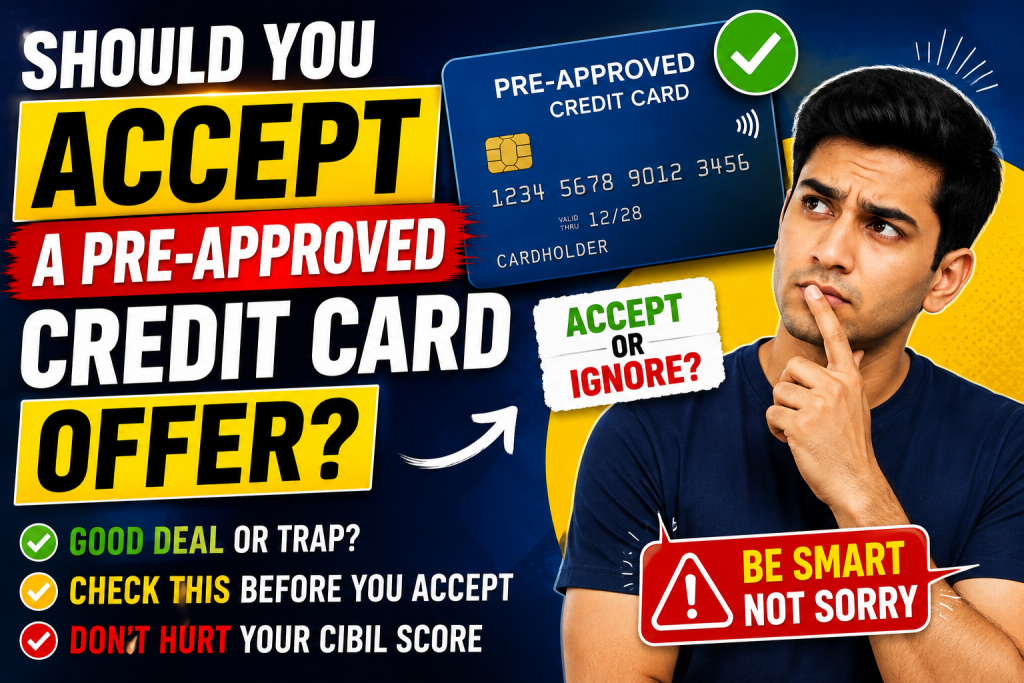
Should You Accept a Pre-Approved Credit Card Offer?

Getting a message saying “Congratulations! You’re pre-approved for a credit card” feels pretty good.
You didn’t even apply for it, and the bank is already saying you’re eligible.
I’ve received these kinds of offers too, and my first thought is usually:
“Okay, what’s the catch?”
A pre-approved offer can be a good deal. But I wouldn’t accept it just because the bank says I’m eligible.
There are a few things I’d check first.
What does pre-approved actually mean?
A pre-approved offer generally means the bank has identified you as someone who may qualify for a particular card based on information it already has about you.
Maybe you already have an account with the bank.
Maybe you have a good credit history.
Maybe you’ve used another product from the same bank before.
But pre-approved doesn’t mean guaranteed approval under every circumstance, and it doesn’t mean the card is automatically the right one for you.
The bank can still have conditions to complete before the card is issued.
So don’t read the word “pre-approved” as:
“The bank has checked everything and this card is definitely free and perfect for me.”
That’s not what it means.
Why did the bank send me the offer?
There can be a few reasons.
If you’ve been using a bank’s savings account, credit card or loan for some time, the bank already has some information about your relationship with them.
It may also see that you have a decent credit profile.
CIBIL says lenders use credit reports and enquiries when evaluating applications for credit cards and loans, but the final lending decision belongs to the lender, not CIBIL.
So if your bank suddenly sends you a pre-approved card offer, it doesn’t necessarily mean you did something special.
It may simply mean the bank thinks the card could be suitable for you.
So, should you accept it?
Maybe.
I’d first look at the card itself.
Forget the word “pre-approved” for a minute and ask:
Would I actually want this card if the bank hadn’t offered it to me?
That’s a pretty good test.
If the answer is no, I wouldn’t take it just because the approval looks easy.
Maybe the card has a ₹1,000 annual fee.
Maybe the rewards don’t match your spending.
Maybe you already have another card that gives you better cashback.
Maybe the bank is offering you a card mainly because it wants you to start spending more.
There’s no rule saying you have to accept every offer you receive.
Check the annual fee first
This is one of the first things I’d look at.
Some pre-approved cards are free for life.
Others may have a joining fee and an annual fee.
And sometimes the bank offers an annual-fee waiver if you spend a certain amount during the year.
That sounds fine until you realise that you’d have to spend ₹2 lakh or ₹3 lakh just to avoid the fee.
I wouldn’t change my spending just to get a fee waiver.
If the card fits my normal spending and I can naturally reach the waiver, great.
If not, I’d rather choose a card with a fee structure that makes sense without forcing me to spend more.
Don’t get distracted by the welcome offer
This happens a lot.
The bank says:
“Get ₹2,000 worth of vouchers.”
Sounds good.
Then you look closer and find out you need to pay the joining fee, spend ₹50,000 in the first three months and complete some other conditions.
That doesn’t automatically make the offer bad.
Just do the math.
If you’re going to spend that amount anyway, the welcome benefit could be useful.
If you’re going to spend extra money only to unlock the offer, I’d skip it.
A credit card shouldn’t make you spend more than you normally would.
Look at the rewards, not the advertisement
A card can advertise “up to 5% cashback” and still be a poor fit for you.
Why?
Because the 5% may apply only to certain merchants or categories.
Maybe you mostly spend on groceries.
Maybe the card gives its best rewards on travel.
Maybe you mostly use UPI and the card’s best categories aren’t useful to you at all.
So I’d look at my own spending first.
For example, if I spend ₹20,000 a month and most of it goes toward Flipkart, fuel and groceries, I’d rather have a card that rewards those things than one with a flashy welcome offer.
That’s much more useful in the long run.
What about the credit limit?
A pre-approved offer may also show you a credit limit.
Don’t get too excited about a big number.
If the bank offers you a ₹5 lakh limit, that doesn’t mean you suddenly have ₹5 lakh more money.
It’s borrowed credit.
That’s it.
A higher credit limit can be useful because it can keep your utilisation lower when you make normal purchases.
But I’d never increase my spending just because the bank increased my limit.
That’s one of the easiest ways to turn a useful credit card into a problem.
Will accepting a pre-approved card affect my CIBIL score?
This part needs a little care.
A lender enquiry is recorded when a bank or financial institution accesses your CIBIL report in connection with a credit application. CIBIL says these enquiries generally have a minimal impact individually, while multiple or frequent enquiries can have a negative effect on your score.
So don’t panic because one pre-approved offer appeared in your account.
But I also wouldn’t accept cards from five different banks at once just because all of them are offering you something.
Think about whether you actually need the card.
That’s the safer approach.
What if the offer says “No impact to your credit score”?
Read the wording carefully.
Sometimes you’re only viewing an offer or checking eligibility.
That’s different from completing a full credit-card application.
The exact process can vary by lender.
I wouldn’t assume that a line saying “check your eligibility” means a hard enquiry definitely won’t happen.
If you’re unsure, look at the bank’s application terms before continuing.
Check whether it’s really lifetime free
This one deserves extra attention.
A card can be advertised as:
“No annual fee”
but that doesn’t always mean it’s a lifetime-free card.
Sometimes the fee is waived for the first year.
Sometimes it’s waived only if you hit a spending target.
Sometimes the offer is valid for a limited period.
So look for the exact wording:
Joining fee: ₹X
Annual fee: ₹X
Annual fee waiver: spend ₹X
That’s much clearer than relying on the big “FREE” banner.
Don’t ignore the interest rate
This may sound obvious, but rewards become almost meaningless if you’re carrying a large unpaid balance.
Credit-card interest can become expensive very quickly.
CIBIL itself advises paying credit-card bills in full and on time rather than repeatedly carrying unpaid balances.
So if you’re taking a card because it gives you 5% cashback but then carrying the balance for months, the cashback isn’t really helping you.
The best way to use a rewards card is pretty boring:
Spend.
Get the rewards.
Pay the full bill.
Repeat.
A pre-approved offer doesn’t mean you need another card
I think this is the part people forget.
Getting another credit card can be useful.
Maybe your current card has a small limit.
Maybe you want a separate card for travel.
Maybe you found a genuinely good lifetime-free cashback card.
Fine.
But if you already have three cards that cover everything you need, a fourth one may just create another bill to remember.
There’s no prize for collecting credit cards.
I’d rather have two useful cards than five cards I barely use.
When I would accept a pre-approved offer
I’d seriously consider it if:
The card has no annual fee, or the fee is easy to justify.
The rewards match what I already spend on.
The credit limit is useful.
There are no annoying conditions that I don’t need.
The card gives me something my existing cards don’t.
And I can pay the bill in full every month.
If all of that checks out, a pre-approved offer can be quite convenient.
There’s no long search for a card and sometimes the application process is simpler.
When I’d say no
I’d probably skip it if:
The annual fee is high.
The rewards don’t match my spending.
I already have a similar card.
The welcome offer requires me to spend money I wouldn’t normally spend.
The bank is offering a card mainly because it thinks I’ll become a bigger borrower.
Or I simply don’t need another card.
That last one is enough reason.
You don’t need to justify saying no to a credit card.
One more thing: check the card after you accept it
Don’t just accept the offer and forget about it.
Once the card arrives, check the name, limit, fees and other details.
Make sure there isn’t some charge you weren’t expecting.
And if you notice anything on your CIBIL report that you don’t recognise, look into it quickly. CIBIL says an unexplained enquiry can sometimes be related to an application you forgot about, a third-party marketplace, or potentially incorrect or unauthorised activity.
My simple rule
I don’t think a pre-approved credit-card offer should automatically be treated as a good deal.
I’d treat it like any other card.
Forget the word “pre-approved” and judge the card itself.
What does it cost?
What does it give you?
Will you actually use the benefits?
Can you pay the bill in full?
If the answers look good, take it.
If not, close the offer and move on.
There will always be another credit-card offer.
Final answer
Should you accept a pre-approved credit card offer?
You can, but don’t accept it just because the bank says you’re already eligible.
Check the annual fee, rewards, credit limit, conditions and the card’s actual usefulness for your spending.
One good card that you understand is much better than a wallet full of cards you don’t really need.
And remember, a credit-card offer is still a loan product.
The bank is offering you access to borrowed money, not free money.
Take the card only when the benefits make sense for you.
Related on AllAbtFin:
3 Credit Card Mistakes That Can Hurt Your CIBIL Score
How to Build a Credit Score From Zero in India
Best Lifetime Free Credit Cards in India
AllAbtFin – Credit Cards & Personal Finance
This article is for general information and isn’t personal financial advice. Always check the card issuer’s current fees, terms and eligibility before accepting an offer.