Can You Have Multiple Savings Accounts in India?

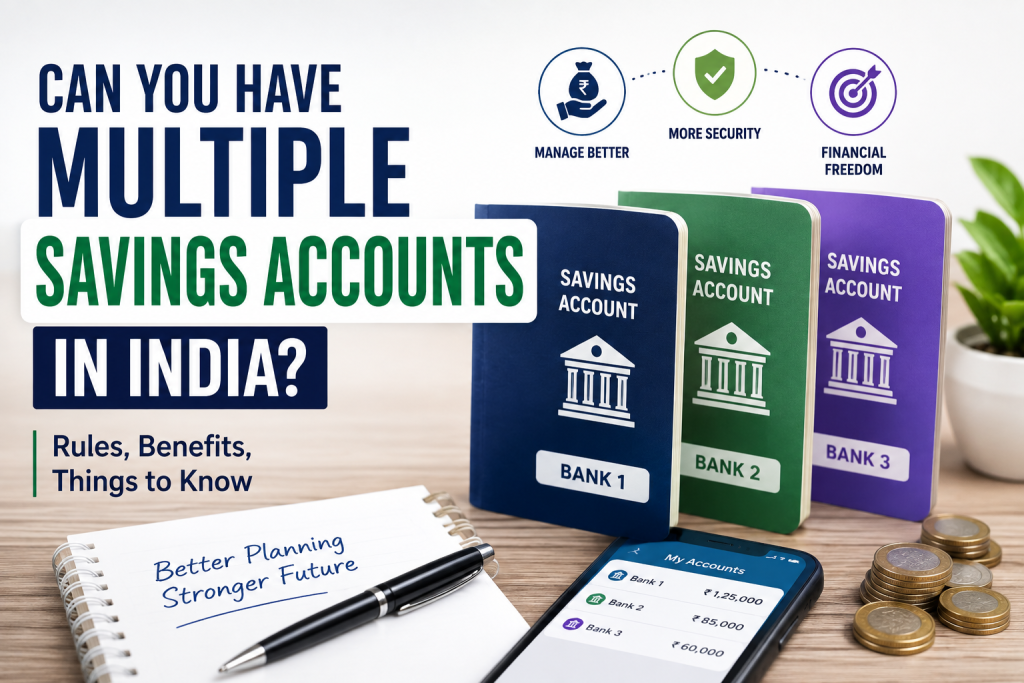
Yes, you can have more than one savings account in India.
There is no general rule that says you must use only one bank account. You can have one account with SBI, another with HDFC Bank, and another with a different bank.
The bigger question is: do you actually need more than one?
For some people, having two or three accounts makes managing money easier. For others, it just means having more bank apps, debit cards and account details to remember.
Why Do People Have Multiple Bank Accounts?
The main reason is usually to keep different types of money separate.
For example, you could use one account for your salary and monthly expenses. Another could be for savings. If you want, you could even keep a separate account for shopping and other day-to-day spending.
It can make budgeting a little easier because you can see where your money is going.
Some people also keep accounts with different banks because they prefer one bank’s app, another bank’s ATM network, or the charges offered by a particular account.
Can You Have Accounts in Different Banks?
Yes.
You can have savings accounts with several different banks at the same time.
For example:
- SBI
- HDFC Bank
- ICICI Bank
- Axis Bank
- Other banks
There is nothing unusual about this.
You just need to meet the eligibility and KYC requirements for each account.
Is Having Multiple Savings Accounts a Good Idea?
It can be, but you don’t need to open several accounts just because you can.
Let’s say you already have one account that has no minimum balance requirement, a good mobile app and everything you need.
Opening three more accounts may not really help.
But if you have a specific reason for each account, it can make sense.
For example:
Account 1: Salary and bills
Account 2: Savings and emergency money
Account 3: Other personal expenses
That’s much easier to manage than putting everything into one account and trying to remember how much of the balance is actually available to spend.
What About Minimum Balance?
This is something you should check before opening another account.
Some savings accounts require you to maintain a minimum balance. If you don’t, the bank may charge you according to the account’s terms.
Other accounts have zero-balance requirements.
So before opening a new account, check the minimum balance rule and the charges that apply if you don’t maintain it.
A bank account may look free when you open it, but that doesn’t necessarily mean every service is free.
Can Multiple Savings Accounts Affect Your CIBIL Score?
No, simply having multiple savings accounts doesn’t hurt your CIBIL score.
A savings account is not the same as a loan or credit card.
Your credit history is mainly affected by how you handle credit accounts such as loans and credit cards.
So don’t open another savings account thinking it will increase your CIBIL score. It won’t.
What If You Have a Lot of Money?
If you’re keeping a large amount of money in bank deposits, having accounts with different banks can sometimes make sense.
One reason is deposit insurance.
DICGC deposit insurance is generally available up to ₹5 lakh per depositor per bank, including principal and interest, subject to the applicable rules.
So if you have a large amount of money sitting in bank deposits, it’s worth understanding how deposit insurance works instead of assuming that every account is covered separately.
Can You Have Two Savings Accounts in the Same Bank?
This depends on the type of account.
Don’t assume that every type of savings account can simply be opened multiple times with the same bank.
For example, there are specific rules around a Basic Savings Bank Deposit Account (BSBDA).
So if you’re thinking about opening another account with the same bank, check the rules for that particular account first.
What Happens If You Stop Using One of Your Accounts?
This is one thing people often forget.
You might open a second account, use it for a few months and then completely stop using it.
Over time, an account that isn’t being used can become inactive or inoperative under the bank’s applicable rules.
That’s why it’s a good idea to keep track of all your accounts.
If you don’t need an account anymore, you can also consider closing it properly rather than leaving it unused.
Do You Need Multiple Debit Cards?
Not really.
If you have three savings accounts, you may end up with three debit cards. There’s nothing wrong with that, but you probably won’t use all of them regularly.
Also check whether any of the cards have annual or other charges.
If you have a card you never use but still pay charges for, it may be worth reconsidering whether you need that account.
How Many Savings Accounts Should You Have?
There’s no magic number.
For one person, one account may be enough.
Someone else might find two or three useful.
I’d look at it this way: every account should have a reason.
If you can’t explain why you have an account, you probably don’t need it.
And having too many accounts can make things more confusing. You have more passwords, cards, statements and balances to keep track of.
Before Opening Another Account
Take a minute and check:
- Is there a minimum balance requirement?
- Is the debit card free?
- Are there annual charges?
- What are the ATM limits?
- Is the mobile banking app good?
- What interest does the account offer?
- Are there charges for services you actually use?
Don’t choose an account just because you saw an advertisement saying “free account.”
Read the actual terms first.
Final Thoughts
Yes, you can have multiple savings accounts in India.
There can be a good reason to have two or three accounts, especially if you want to separate your salary, spending and savings.
But more accounts don’t automatically mean better money management.
If one account does everything you need, there’s nothing wrong with keeping things simple. If you do open another account, make sure there’s a clear reason for it and keep track of what you’re paying for.