Axis Flipkart Credit Card vs SBI Flipkart Credit Card: Which Is Better?

If you’re looking for a credit card mainly for Flipkart shopping, you may have noticed something a little confusing.
There are now two different Flipkart credit cards — one from Axis Bank and one from SBI Card.
Both give cashback on Flipkart. Both also give extra benefits on Myntra and other merchants. And both charge a ₹500 annual fee, which can be waived if you spend enough during the year.
So, which one should you actually get?
The answer isn’t as simple as saying one card is always better.
It mostly comes down to where you shop and how much you spend.
I’ve compared the two below in simple terms.
Axis Flipkart Credit Card vs SBI Flipkart Credit Card
Here is the basic comparison:
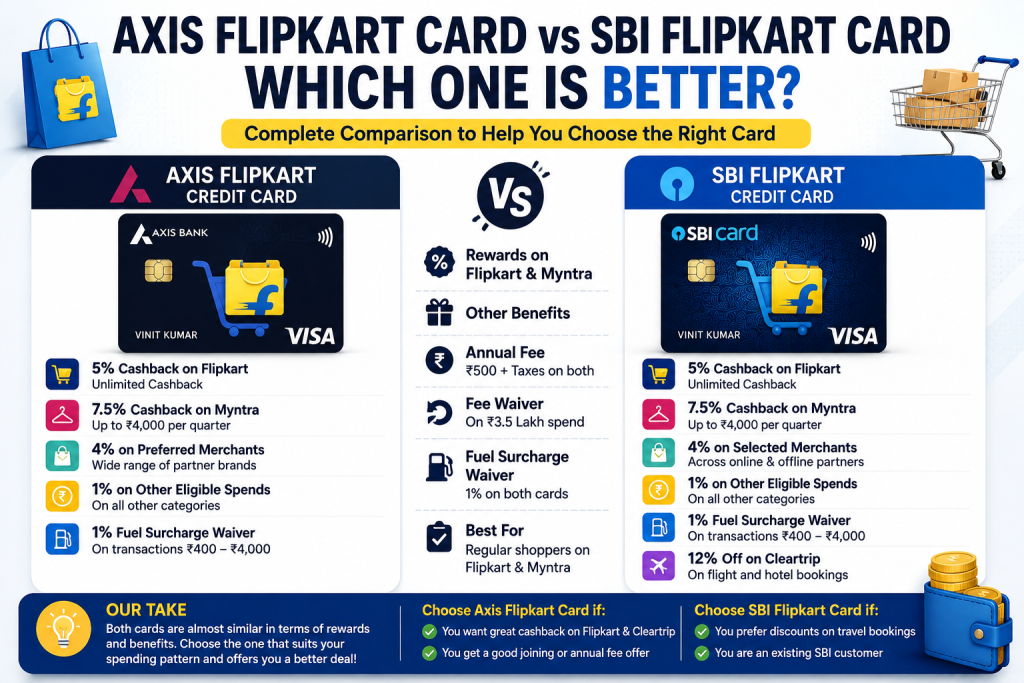
| Feature | Flipkart Axis Bank Credit Card | Flipkart SBI Card |
| Flipkart cashback | 5% | 5% |
| Myntra cashback | 7.5% | 7.5% |
| Other eligible spends | 1% | 1% |
| Selected merchants | 4% | 4% |
| Annual fee | ₹500 + taxes | ₹500 + taxes |
| Fee waiver | ₹3.5 lakh annual spend | ₹3.5 lakh annual spend |
| Fuel surcharge waiver | 1% | 1% |
| Cleartrip benefit | Cashback | Discount |
| Cashback credited | Credit-card statement | Credit-card account |
The headline numbers are surprisingly similar. Axis Bank currently lists 5% cashback on Flipkart and Cleartrip, 7.5% on Myntra, 4% on preferred merchants and 1% on other eligible categories. (Axis Bank)
SBI’s new Flipkart card also gives 5% cashback on Flipkart, 7.5% on Myntra, 4% on selected merchants and 1% on other eligible spending. (SBI Card)
So this isn’t really a case where one card gives 5% and the other gives 10%.
They are much closer than that.
Let’s Start With Flipkart Shopping
This is probably the first thing you want to know.
If you spend ₹10,000 on eligible Flipkart purchases, a 5% cashback rate works out to ₹500.
And both cards currently advertise 5% cashback on Flipkart spending. (Axis Bank)
So if you’re choosing between these two cards purely because you shop on Flipkart, there isn’t a huge difference here.
This is actually one of the reasons the comparison is interesting.
The cashback rate itself doesn’t give you an obvious winner.
You’ll have to look at the other parts of the cards.
What About Myntra?
This is another area where the two cards are almost identical.
Both offer 7.5% cashback on Myntra.
Axis Bank currently lists a ₹4,000 cashback cap per statement quarter for Myntra spending. (Axis Bank)
SBI also advertises 7.5% cashback on Myntra on its Flipkart SBI Card. (SBI Card)
So if you’re someone who regularly shops on both Flipkart and Myntra, either card can be useful.
I wouldn’t choose one over the other just because of the Myntra percentage.
Where Things Start Getting Interesting
The difference becomes more noticeable when you look beyond Flipkart.
The Axis card gives 4% cashback on its listed preferred merchants and 1% on other eligible categories. (Axis Bank)
SBI’s card follows a similar structure, with 4% cashback on preferred/select merchants and 1% on other eligible spending. (SBI Card)
That means the two cards are again quite similar for everyday use.
But the list of merchants and the terms attached to those cashback categories matter.
And those lists can change.
So don’t assume that a merchant getting 4% today will necessarily remain in the same category forever.
The Annual Fee Is the Same
This part is easy.
Both cards currently have a ₹500 joining fee and ₹500 annual/renewal fee, plus applicable taxes.
The annual fee can be reversed if you reach ₹3.5 lakh in annual spending.
Axis Bank lists the annual-fee waiver at spending above ₹3.5 lakh. (Axis Bank)
SBI also lists the same ₹3.5 lakh annual spending requirement for reversal of the renewal fee. (SBI Card)
So again, there isn’t much separating them.
If you spend ₹3.5 lakh or more in the relevant period, the annual fee can be waived.
If you don’t, you’ll generally have to pay it.
And remember, ₹500 isn’t actually ₹500 after taxes.
What If I Don’t Spend ₹3.5 Lakh?
This is where I’d stop and think before applying.
Let’s say you spend ₹1 lakh a year on the card.
You won’t reach the ₹3.5 lakh fee-waiver target.
So you’ll pay the annual fee.
That doesn’t automatically make the card bad.
If you earn much more cashback than the fee, the card can still be worth keeping.
For example, if your card earns ₹4,000 in useful cashback over the year and your annual fee is ₹500 plus taxes, you’re still ahead.
But don’t spend extra money just to reach ₹3.5 lakh and avoid the fee.
If you normally spend ₹2 lakh, spending another ₹1.5 lakh just to save ₹500 makes absolutely no sense.
Which Card Is Better for Flipkart?
If Flipkart is your main reason for getting the card, both are good choices.
The cashback rate is 5% on both.
So I’d look at the offer you’re actually getting.
For example, maybe Axis Bank gives you a first-year-free offer.
That’s worth considering.
Axis currently says first-year-free cards don’t qualify for some of the paid-card welcome voucher benefits, so you should check exactly what your application offer contains. (Axis Bank)
SBI also has its own welcome benefits and fee-related conditions. Its current page lists a ₹250 Flipkart gift card on fee realisation and other welcome benefits subject to the applicable terms. (SBI Card)
Don’t compare someone else’s welcome offer with yours.
Check the offer shown when you apply.
SBI Has a Nice Advantage for Cleartrip
If you book travel through Cleartrip, the SBI card may be interesting.
SBI currently advertises 12% off on Cleartrip with the Flipkart SBI Card. (SBI Card)
Axis takes a slightly different approach.
The Axis Flipkart card currently gives 5% cashback on eligible Cleartrip spending, subject to the applicable cap. (Axis Bank)
So this is one area where you shouldn’t simply compare the percentage numbers.
A discount and cashback aren’t necessarily the same thing.
The actual Cleartrip offer will depend on the booking, transaction and terms.
If you use Cleartrip regularly, I’d check the current offer before choosing between the cards.
What About Fuel?
Both cards have a fuel surcharge waiver.
Axis currently lists a 1% fuel surcharge waiver on eligible fuel transactions between ₹400 and ₹4,000, with a maximum benefit of ₹400 per statement cycle. It also says no cashback is earned on fuel transactions. (Axis Bank)
SBI also lists a 1% fuel surcharge waiver, with the maximum waiver currently shown as ₹400 per statement cycle. (SBI Card)
So there isn’t a big reason to choose one card over the other just for fuel.
And I wouldn’t get either card specifically as a fuel card.
There are better cards for that purpose.
Which One Gives Better Cashback?
This is probably the question people expect me to answer.
But honestly, the cashback rates are so similar that the answer depends on your spending.
For example:
If you spend ₹50,000 on Flipkart
5% cashback = ₹2,500
The basic calculation is the same for both cards, assuming the spending qualifies under the current terms and hasn’t crossed the applicable cashback cap.
If you spend ₹50,000 on Myntra
7.5% cashback = ₹3,750
Again, the headline rate is the same.
So there isn’t much point in saying:
“Axis gives better cashback.”
or
“SBI gives better cashback.”
The more accurate answer is that both have a very similar cashback structure.
One Thing You Should Not Ignore: Cashback Limits
This is where a lot of credit-card comparisons become misleading.
People see:
5% cashback
and immediately assume they’ll get 5% on everything they spend.
That’s not how it works.
There can be merchant-specific limits, category exclusions and transaction conditions.
For example, Axis currently lists a ₹4,000 quarterly cashback cap for Flipkart and another ₹4,000 quarterly cap for Cleartrip, while Myntra also has a ₹4,000 quarterly cap. (Axis Bank)
So if you spend a huge amount, don’t simply multiply the entire amount by 5%.
Check the cap first.
That’s especially important during big shopping events when someone might spend ₹1 lakh or more on a card in a short period.
Which Card Is Better for Everyday Spending?
I’d say this is pretty close.
Both cards give 1% cashback on other eligible spending, while selected merchants can earn more. (Axis Bank)
But I wouldn’t use either card as my only card if most of my spending falls into categories that don’t earn good cashback.
That’s because a flat 1% isn’t particularly exciting anymore.
There are other cards in India that can offer better returns on general spending.
These two cards make much more sense when you actually use their shopping-related benefits.
In other words:
Buy a lot on Flipkart or Myntra → these cards make sense.
Rarely shop on either → look at other credit cards.
What If I Already Have an Axis Credit Card?
Then I’d check whether having another Axis card actually makes sense.
If your existing card already covers your shopping and cashback needs, getting another card simply because Flipkart is offering one may not add much value.
The same goes for SBI.
Having a card from the same issuer isn’t automatically better.
Choose based on the benefits, not the bank’s name.
Axis Flipkart vs SBI Flipkart: My Verdict
If I had to make the choice simple, I’d put it like this.
Pick Axis Flipkart if:
You regularly shop on Flipkart and Myntra and the Axis offer you’re receiving is attractive.
The card currently gives 5% cashback on Flipkart and Cleartrip, 7.5% on Myntra, 4% at preferred merchants and 1% on other eligible spending. (Axis Bank)
Pick SBI Flipkart if:
You like the SBI ecosystem, want the Cleartrip discount and receive a good joining/welcome offer.
The SBI card also gives 5% on Flipkart, 7.5% on Myntra, 4% on selected merchants and 1% on other eligible spends. (SBI Card)
If both offers are exactly the same?
Then honestly, I’d choose based on which bank gives me the better application offer and which app/customer service experience I prefer.
There isn’t a massive cashback difference between them.
So, Which One Would I Choose?
If both banks offered me exactly the same deal, I’d probably look at the actual spending pattern first.
If I shop heavily on Flipkart, either card works.
If I use Myntra regularly, again, both work.
If I use Cleartrip, I’d compare the exact current offer because SBI’s advertised discount and Axis’s cashback work differently.
And if one bank offers me the card as first-year free, that could easily break the tie.
I wouldn’t pay an annual fee just because a credit card looks attractive on paper.
I’d also avoid getting both cards unless there is a genuine reason to have both.
Having two cards that give almost the same rewards can simply mean two statements to remember.
One Last Thing About These Cards
Don’t use either card just to “earn cashback.”
That sounds obvious, but it’s surprisingly easy to fall into.
Suppose you see a ₹40,000 phone on Flipkart.
You don’t really need it, but you think:
“I’ll get 5% cashback.”
That’s not saving money.
You’re still spending ₹40,000.
The cashback is just a small discount on money you were already going to spend.
The best way to use these cards is much simpler:
Buy what you were already planning to buy, use the card, get the cashback and pay the full bill on time.
That’s where the real value is.
Final Answer
Between the Axis Flipkart Credit Card and SBI Flipkart Credit Card, I wouldn’t call either one an obvious winner.
Their core cashback rates are almost identical:
- 5% on Flipkart
- 7.5% on Myntra
- 4% on selected/preferred merchants
- 1% on other eligible spends
Both currently carry a ₹500 annual fee plus taxes, with the fee reversed at ₹3.5 lakh annual spending. (Axis Bank)
So the better card for you is mostly going to depend on the offer you receive and where you actually spend your money.
If you’re a regular Flipkart shopper, either can be a good card.
If one comes with a better first-year-free or welcome offer, I’d take that one.
And if you barely use Flipkart or Myntra, I’d skip both and look for a card that rewards the things you actually spend money on.