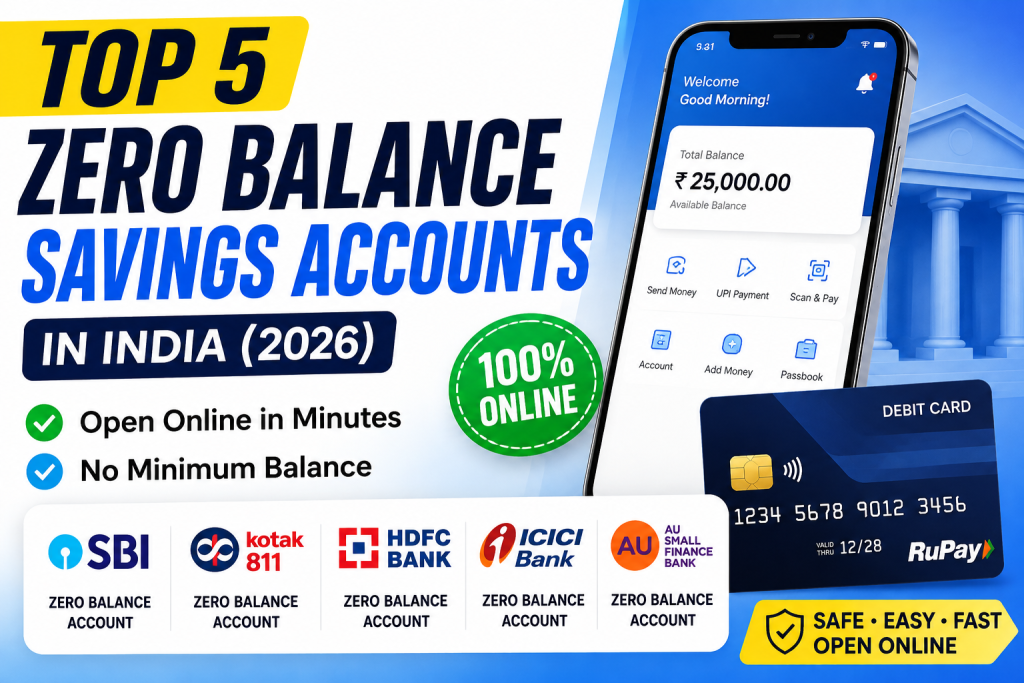
Top 5 Zero Balance Savings Accounts in India (2026) | Open Online

Explore five popular zero balance savings account options in India for 2026. Learn eligibility, documents, online account-opening steps, KYC basics, and how to choose.
Opening a savings account in India no longer has to mean visiting a branch, waiting in queues, and carrying a file full of papers. Many banks now offer a digital application journey that can begin from your phone or laptop. For students, first-time earners, homemakers, and anyone who prefers not to maintain a monthly minimum balance, a zero balance savings account can be a practical starting point.
In this guide, we look at five widely known options that are commonly considered by people searching for a zero balance savings account in India: SBI Basic Savings Bank Deposit Account (BSBDA), Kotak 811, HDFC Bank Basic Savings Bank Deposit Account, ICICI Bank Basic Savings Account, and AU Small Finance Bank’s relevant digital savings-account options.
The right choice depends on your eligibility, banking habits, location, and the services you need. Account names, benefits, transaction limits, debit-card availability, and onboarding methods can change, so always confirm the latest details on the respective bank’s official website before applying.
What Is a Zero Balance Savings Account?
A zero balance savings account is a savings account where the bank does not require you to maintain a specified minimum balance. In simple terms, you may not need to keep a fixed amount in the account every month simply to avoid a minimum-balance shortfall charge.
Depending on the bank and account variant, you may be able to access services such as:
- UPI payments and QR-code payments
- Mobile banking and internet banking
- Debit card facilities, subject to the account terms
- ATM cash withdrawals, within applicable limits
- Fund transfers and bill payments
- SMS or email alerts, where offered
However, “zero balance” does not mean every service is free or unlimited. Banks can set conditions for ATM transactions, physical debit cards, cheque books, SMS alerts, cash deposits, account conversion, and other services. Read the schedule of charges and the account’s terms before you submit your application.
Top 5 Zero Balance Savings Accounts in India for 2026
Here are five popular options to explore if you want to open a zero balance bank account online in India. This is not a ranking of guaranteed benefits; it is a practical shortlist to help beginners compare familiar banking choices.
1. SBI Basic Savings Bank Deposit Account (BSBDA)
The SBI Basic Savings Bank Deposit Account, often called BSBDA, may appeal to people who prefer a large public-sector bank with an extensive branch and ATM presence. State Bank of India is a familiar name across cities, towns, and many semi-urban and rural areas, which can be reassuring if you expect to need branch support later.
The BSBDA is designed as a basic banking product and is generally associated with no minimum-balance requirement. It may include basic banking facilities under the applicable rules. Services, withdrawal limits, debit-card facilities, and digital access are subject to SBI’s current account terms.
Why beginners may consider SBI BSBDA
- A well-known public-sector banking network
- Scope for basic day-to-day banking needs
- Potential access to digital banking and UPI after activation, subject to eligibility
- Branch access may be useful when you need assistance with KYC or account servicing
How to start the application
You can check the current savings-account journey through SBI’s official website or the YONO SBI app. The process may involve entering your mobile number, validating it through an OTP, providing identity details, and completing KYC. In some cases, a branch visit or additional verification may be required. Follow the instructions displayed by the bank for your chosen account type.
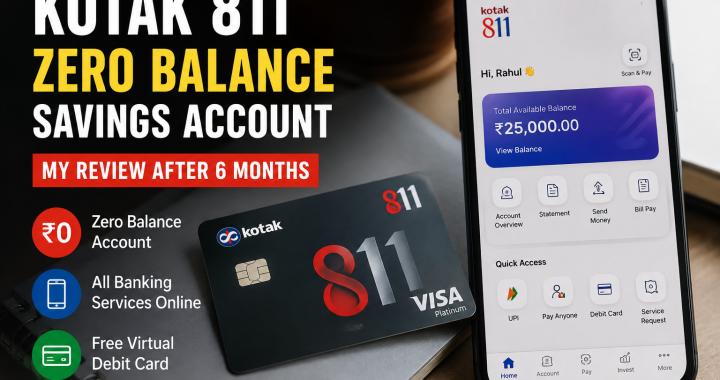
2. Kotak 811 Zero Balance Account
Kotak 811 is widely recognised for its digital-first account-opening experience. It can be a convenient option for applicants who are comfortable using an app or website and want to begin their banking journey online.
Kotak 811 account variants and onboarding requirements can differ. A digital account may provide features such as an account number, UPI access, online payments, and a virtual or physical debit-card option, depending on the current product terms and successful completion of KYC.
Why beginners may consider Kotak 811
- Digital-led application process
- Designed for app-based banking convenience
- Suitable for people who use UPI and online payments regularly
- Potentially useful if you prefer managing banking from your smartphone
How to start the application
Visit the official Kotak 811 page or download the official app. Usually, you begin with your mobile number and OTP verification, then enter PAN and Aadhaar-related details as requested. Fill in your personal information carefully and complete the required KYC process, which may include video KYC. Activation timing and available features depend on bank verification and current terms.
3. HDFC Bank Basic Savings Bank Deposit Account
HDFC Bank offers basic savings-account options that may suit customers seeking a private-bank relationship without a minimum-balance requirement on the relevant account category. Before applying, make sure you select the specific Basic Savings Bank Deposit Account or other suitable zero-balance variant rather than assuming every HDFC savings account has the same balance requirement.
HDFC Bank’s digital channels may help you begin an application online, while the exact completion path can vary by customer profile, service location, KYC status, and the selected account.
Why beginners may consider HDFC Bank
- Established private-sector bank
- Digital banking channels for routine transactions
- Possibility of debit-card, net-banking, mobile-banking, and UPI access, subject to the product terms
- May suit customers who value a broad range of banking services as their needs grow
How to start the application
Go to HDFC Bank’s official website or app and locate the current savings-account application page. You may be asked to verify a mobile number by OTP, provide PAN and Aadhaar details, submit personal information, and complete KYC. If video KYC is offered for your chosen journey, ensure that your camera, internet connection, and original documents are ready. Do not assume instant approval; the bank will activate the account only after completing its checks.
4. ICICI Bank Basic Savings Account
ICICI Bank is another widely used private-sector bank with strong digital banking visibility. Its basic savings-account offering may be worth checking if you want to use an app for UPI, transfers, and regular account management.
As with all banks, ensure that the account you select is actually a zero balance or basic savings account under the bank’s current definitions. Features such as debit cards, ATM usage, online transfers, and account-opening timelines can vary by product and eligibility.
Why beginners may consider ICICI Bank
- Convenient digital channels for common banking tasks
- Familiar choice for people who want app-based account management
- May offer online application and KYC options for eligible applicants
- UPI and digital-payment access may be available after account setup, subject to current terms
How to start the application
Start only through ICICI Bank’s official website or official mobile app. The usual flow may include mobile OTP verification, PAN and Aadhaar submission, personal-information entry, and KYC. A video KYC or another verification step may be requested. Review every screen before submitting the form, especially the account type, declarations, and applicable charges.
5. AU Small Finance Bank Digital Savings Account Options
AU Small Finance Bank is often considered by customers looking for a digital banking experience from a small finance bank. It may have savings-account products with low or zero balance requirements, but the exact eligibility and account variant should be checked directly on its official website.
Small finance banks can be worth exploring alongside larger banks, particularly if the available account features match your requirements. Still, compare the complete product terms rather than choosing based on a single feature.
Why beginners may consider AU Small Finance Bank
- Digital onboarding may be available for eligible applicants
- App-based banking and UPI facilities may be offered, subject to the selected product
- A useful alternative to compare with larger public and private banks
- May suit people comfortable with fully digital account management
How to start the application
Use the official AU Small Finance Bank website or app to identify the current zero-balance or suitable savings-account option. You may need to verify your mobile number, share PAN and Aadhaar details, complete personal details, and finish video KYC or another KYC method. The bank’s approval process, serviceability, and feature availability will determine the final outcome.
Documents Needed to Open a Zero Balance Account Online
Although requirements can vary, keep these details ready before you begin:
- Aadhaar card or Aadhaar details, where accepted for the selected journey
- PAN card or PAN details
- Your own active mobile number, ideally linked to Aadhaar if required for OTP-based verification
- Email address, if requested
- A smartphone or computer with a camera and stable internet for video KYC
- Original documents for verification, where applicable
The bank may request additional information or documents based on regulatory requirements, your address, occupation, or application profile. Never share OTPs, PINs, CVV numbers, or passwords with anyone claiming to assist you.
How to Open a Zero Balance Savings Account Online: Common Steps
The exact screens differ from bank to bank, but the process commonly looks like this:
- Choose the right account variant. Confirm that it is a basic or zero balance savings account and read the key terms.
- Apply through the official website or app. Avoid links from unknown messages, social-media comments, or unofficial agents.
- Enter your mobile number. Verify it using the OTP sent by the bank.
- Provide PAN, Aadhaar, and personal details. Enter names, date of birth, address, and other data exactly as requested.
- Review declarations and charges. Check the service conditions before giving consent.
- Complete KYC. This could involve video KYC, Aadhaar-based verification, or a branch visit, depending on the bank and your eligibility.
- Wait for confirmation. The bank may share your account status, account number, or next steps after successful verification.
- Set up secure banking. Activate mobile banking, create strong credentials, and register for UPI only through official channels.
How to Choose the Best Zero Balance Account for You
There is no single best zero balance savings account for every person. Use your own needs as the filter.
| If your priority is… | You may want to compare… |
|---|---|
| Public-sector bank presence | SBI BSBDA and local branch access |
| A digital-first application | Kotak 811 and other app-led journeys |
| Private-bank ecosystem | HDFC Bank or ICICI Bank basic savings options |
| Comparing a small finance bank | AU Small Finance Bank’s current savings options |
| Everyday UPI use | App experience, activation process, and support options |
Before deciding, check whether the account has any limits that matter to you, such as transaction frequency, ATM usage, debit-card conditions, or requirements for specific facilities. If you expect to receive salary credits, business payments, or high-value transfers, ask the bank whether a basic account is suitable for that purpose.
Important Tips Before You Apply
- Apply only on the bank’s official app, website, or verified branch channel.
- Use your own mobile number and email address.
- Keep your Aadhaar and PAN details accurate and available.
- Complete video KYC in a quiet, well-lit place with reliable internet.
- Do not submit several applications at once unless you genuinely want multiple accounts.
- Read the bank’s latest terms, product brochure, and schedule of charges.
- Check whether a physical debit card requires a request, fee, or separate delivery step.
Frequently Asked Questions
Can I open a zero balance savings account without visiting a branch?
In many cases, banks allow eligible customers to start and sometimes complete the process online through OTP verification and video KYC. However, a branch visit may still be required depending on the account, location, KYC outcome, or bank policy.
Is a zero balance savings account safe?
A savings account with an RBI-regulated bank is subject to applicable banking and regulatory frameworks. For your own safety, use only official channels and protect your OTP, PIN, passwords, and card details.
Can students open a zero balance account in India?
Students may be eligible to open a suitable savings account, subject to age, KYC, and the bank’s product rules. Minors may need a parent or guardian and a specific minor-account variant.
Will I get a debit card with a zero balance account?
A virtual or physical debit card may be offered with some account variants, but availability, eligibility, delivery, and charges depend on the bank’s current terms. Confirm this before applying.
Do I need Aadhaar-linked mobile access?
It is often helpful for OTP-based verification and Aadhaar-related digital onboarding. The exact requirement depends on the bank’s process and the KYC method used.
Final Thoughts
A zero balance savings account can make it easier to start managing money, receiving payments, using UPI, and building healthy financial habits—without the pressure of maintaining a fixed minimum balance. SBI BSBDA, Kotak 811, HDFC Bank, ICICI Bank, and AU Small Finance Bank are useful starting points for comparison, not automatic one-size-fits-all recommendations.
Take a few minutes to compare the current account terms, KYC requirements, digital features, and applicable charges on each bank’s official website. Once you choose an account that fits your needs, apply through the official channel and begin your banking journey with confidence.