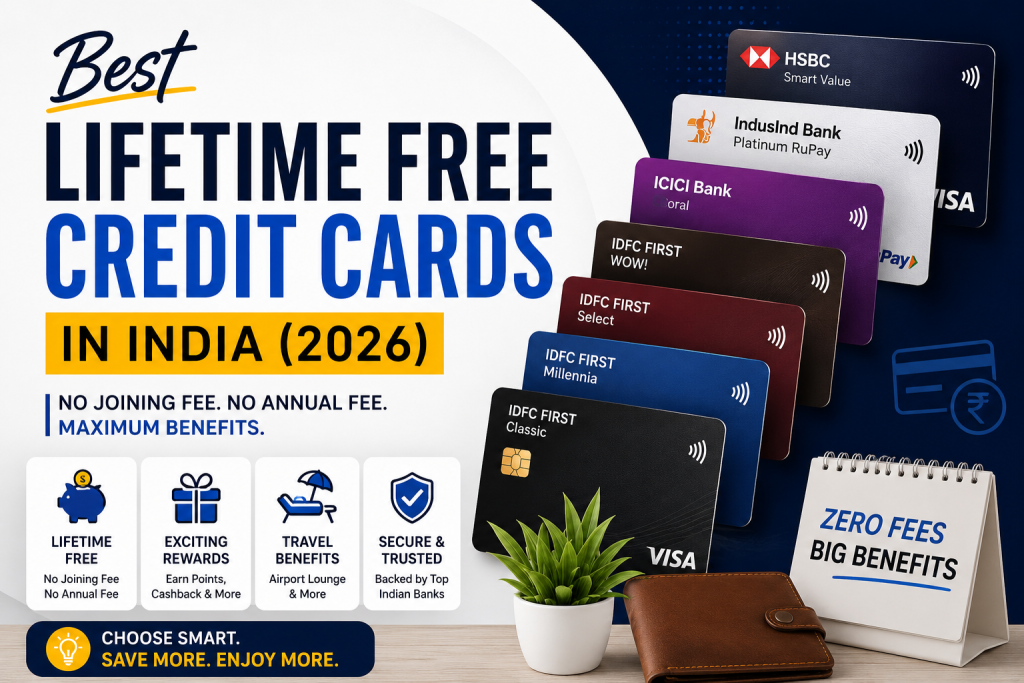
Best Lifetime Free Credit Cards in India (2026)

A credit card doesn’t always need to come with a yearly bill.
There are cards in India where the bank doesn’t charge you a joining fee or an annual fee. These are usually called lifetime-free credit cards, or simply LTF cards.
For someone who uses a credit card regularly, this can be useful. You get the convenience of a credit card without having to worry about paying a renewal fee every year.
But there is a catch.
Not every card advertised as “free” is actually free for everyone. Sometimes the lifetime-free offer is available only to selected customers. Sometimes the card is free only if you apply through a particular offer. And a card with no annual fee can still have charges for things like cash withdrawals, late payments or other services.
So I wouldn’t choose a card just because the words “Lifetime Free” are written on the application page.
Look at what you actually get from it.
Here are some of the cards worth considering in 2026.
IDFC FIRST Classic Credit Card
If you want a straightforward credit card and don’t particularly care about having a fancy premium card, the IDFC FIRST Classic is one of the cards I’d put on the list.
IDFC FIRST Bank currently lists the Classic among its lifetime-free credit cards. Its current credit-card fee document also shows no joining fee and no annual fee for the Classic.
The main attraction here isn’t some massive cashback number.
It’s the fact that you can keep the card without worrying about an annual membership fee.
That makes a difference if you are someone who doesn’t spend enough every year to justify paying ₹500, ₹1,000 or more for a card.
You can use it for normal purchases, earn rewards and use the other benefits available with the card.
There are also benefits around things such as railway lounge access and fuel transactions, although the exact rules and eligibility conditions can change.
So I would check the current terms before applying rather than relying on an old credit-card comparison you found online.
For someone who simply wants a no-fee card for everyday spending, the Classic is a reasonable place to start.
IDFC FIRST Millennia Credit Card
The IDFC FIRST Millennia is another option if most of your spending happens online.
The card is listed by IDFC FIRST Bank as a lifetime-free card, and the bank’s current fee document lists no joining fee or annual fee for the Millennia.
The card has a reward system that gives higher rewards on certain online spending, subject to the card’s applicable limits and conditions.
This is where I would tell you not to get too excited about the word “rewards.”
Getting 5X or 10X points sounds great on a banner. What matters is how much those points are actually worth when you redeem them.
A card can advertise a high number of reward points and still give you less real value than a simple cashback card.
The Millennia can make sense if your spending matches the categories where it gives you better rewards.
If most of your expenses are groceries, rent, utilities and other transactions that don’t earn the higher reward rate, you may not get as much out of it.
So look at your own spending for the last two or three months.
That’s a much better way to choose a credit card than looking at a list of “best cards.”
IDFC FIRST Select Credit Card
If you want something a little more feature-heavy, there’s the IDFC FIRST Select.
It is also listed in IDFC FIRST Bank’s lifetime-free range.
The Select card is more interesting for someone who travels occasionally and wants some travel-related benefits without taking on an annual card fee.
The card has had benefits around airport and railway lounge access, rewards and other lifestyle offers. The exact lounge rules and spending requirements matter, though, so make sure you check the current terms before counting on free lounge visits.
That’s something people often miss.
A card may say “airport lounge access” in big letters, but when you read the terms, you might find a minimum spending requirement for the previous quarter.
If you don’t normally spend that much, the benefit isn’t really worth much to you.
Still, for someone who already spends enough and wants a lifetime-free card with additional travel features, Select is worth looking at.
IDFC FIRST WOW! Credit Card
This one is different from the others.
The IDFC FIRST WOW! is a secured credit card. In simple words, you put money into a Fixed Deposit and the card is issued against it.
That makes it particularly interesting for someone who is new to credit.
Maybe you are 18 or 19 and have never had a credit card.
Maybe you are self-employed and don’t have the income documents normally requested for some unsecured cards.
Or perhaps your credit history is simply too short.
A secured card can give you another route.
IDFC FIRST Bank includes FIRST WOW! in its lifetime-free card range, and its card documents list the card with no joining or annual fee.
The important thing is not to forget what “secured” means.
Your Fixed Deposit is still your money. You aren’t getting a free loan from the bank.
You’re basically giving the bank security while getting access to a credit card.
For someone who wants to start building a credit history, that can be useful.
And there’s another benefit: you don’t need to chase a huge credit limit when you’re just starting out.
A small limit is perfectly fine.
In fact, it can make it easier to control your spending.
ICICI Bank Coral Credit Card
The ICICI Bank Coral Credit Card is another card you may come across when looking for a lifetime-free option.
ICICI Bank currently says that the Coral can be offered with no joining fee and no annual fee, but this is subject to eligibility and the bank’s terms.
That’s an important distinction.
Don’t assume that every person applying for Coral will automatically receive it as lifetime free.
The offer can depend on how you are being offered the card and whether you meet the conditions.
If you do get a genuine lifetime-free Coral offer, the card has some useful everyday benefits.
For example, ICICI lists movie discounts and domestic airport lounge access, with spending conditions attached to lounge access. The bank also lists fuel surcharge benefits and reward points.
The movie benefit can be useful if you actually go to the cinema.
If you don’t, then it’s basically just another feature sitting on the card’s brochure.
That’s why I wouldn’t rank a card higher just because it has more benefits.
The useful benefits are the ones you actually use.
IndusInd Bank Platinum RuPay Credit Card
Another card worth knowing about is the IndusInd Bank Platinum RuPay Credit Card.
IndusInd Bank has described this card as lifetime free, with no joining or annual fee.
The RuPay network also makes this type of card interesting for people who want to use a credit card through UPI for eligible merchant payments.
That doesn’t mean you should suddenly move every UPI payment to a credit card.
Credit cards are still borrowed money.
If you use the card for small daily payments and then forget to pay the bill, the rewards won’t matter much once interest and charges start piling up.
But if you’re disciplined with your payments, a RuPay credit card can be convenient for certain everyday transactions.
HSBC Smart Value Credit Card
The HSBC Smart Value Credit Card is another genuine no-fee option worth knowing about.
HSBC currently lists the Smart Value with no joining fee and no annual fee.
The card earns reward points on spending, with additional reward points on certain categories such as online, dining and telecom spending, subject to the applicable cap.
There’s also an EMI facility for eligible purchases.
I wouldn’t call this the most exciting card on the market.
And that’s actually fine.
Not every credit card needs to be exciting.
For someone who wants a simple card without a joining or annual fee, it can be worth comparing with the other options available to them.
So Which One Should You Actually Pick?
This is where credit-card lists usually become a little misleading.
Someone says:
“Card A is the best.”
But there really isn’t one best card for everyone.
Imagine two people.
The first person spends most of their money online. They order food, shop online and pay for subscriptions.
The second person mostly uses their card for fuel, groceries and occasional travel.
Giving both of them the same card and calling it “the best” doesn’t make much sense.
Your spending matters.
If you travel, look at travel benefits.
If you shop online, look at online rewards.
If you mostly want to build your credit history, don’t worry about getting a premium card with dozens of benefits.
A simple card that you can manage properly is enough.
What Does “Lifetime Free” Actually Mean?
This is probably the most important part of the whole article.
When a card is genuinely lifetime free, it generally means you don’t have to pay the joining fee or annual renewal fee.
It does not mean every transaction on the card is free.
You can still have charges for things such as:
- Cash withdrawals
- Late payments
- Foreign currency transactions
- Certain EMI services
- Card replacement
- Other specific transactions
For example, IDFC FIRST Bank’s current card terms list separate charges and finance costs even though several of its card variants have zero joining and annual fees.
That’s completely normal.
“Lifetime free” refers to the card membership fee. It isn’t a promise that the bank will never charge you for anything.
Don’t Confuse “Free for the First Year” With Lifetime Free
This is another common mistake.
Suppose a bank says:
“₹0 annual fee for the first year.”
That does not mean the card is lifetime free.
You may start paying the annual fee from the second year.
Some cards also offer an annual-fee waiver if you spend a certain amount during the year.
That’s different again.
For example, a card might have a ₹1,000 annual fee but waive it if you spend ₹1 lakh in a year.
That can be perfectly reasonable if you already spend ₹1 lakh.
But if you have to spend money you wouldn’t normally spend just to avoid a ₹1,000 fee, you’re not really saving money.
You’re just spending more to avoid a charge.
What About the Annual Fee Waiver?
Suppose your card costs ₹1,000 a year but the bank says the fee will be reversed if you spend ₹2 lakh.
Ask yourself whether you’d naturally spend ₹2 lakh.
If yes, the card could work.
If no, a genuine lifetime-free card may be better.
This is one reason I like lifetime-free cards for people who don’t spend heavily.
You don’t have to keep checking whether you’ve crossed the bank’s annual spending target.
The card can just sit in your wallet and be available when you need it.
Is a Lifetime-Free Card Better Than a Paid Card?
Not necessarily.
A paid credit card can be much more rewarding if you actually use its benefits.
For example, someone who travels frequently might easily recover a ₹5,000 annual fee through travel rewards, lounge access or other benefits.
But if you spend only ₹10,000 or ₹20,000 a month and don’t use the premium benefits, paying thousands of rupees every year may not make much sense.
This is why I wouldn’t automatically choose a lifetime-free card just because it’s free.
Look at the value you get after fees.
A ₹5,000 card that gives you ₹10,000 worth of useful benefits is better than a free card that gives you ₹500 worth of benefits.
Free isn’t always better.
It’s just cheaper.
What About Credit Score?
A lifetime-free credit card can also be useful if you’re trying to build a credit history.
But there’s a simple rule here:
Don’t carry a balance just to build your credit score.
If you spend ₹10,000 and your statement says ₹10,000 is due, pay the full amount by the due date if you can.
You don’t need to deliberately leave ₹2,000 unpaid and pay interest.
That doesn’t make financial sense.
HSBC also explains that responsible credit-card use, including paying the statement in full and on time, can help build credit history.
The same basic principle applies regardless of which bank’s card you choose.
Don’t Get Five Cards Just Because They’re Free
This is something I would personally avoid.
You find one lifetime-free card.
Then another bank offers another one.
Then another card promises better rewards.
Before long, you have five cards sitting in your wallet.
None of them has an annual fee, so it feels harmless.
But you now have five statements to check, five credit limits to remember and five different sets of terms.
It’s easy to miss a payment.
And missing a payment can cost far more than the annual fee you were trying to avoid.
For most people, one or two good cards are enough.
Add another only when there is a real reason.
Check the Offer Before You Apply
This matters especially with cards advertised as lifetime free.
Take the ICICI Coral as an example.
ICICI’s current pages show that a no-joining-fee and no-annual-fee Coral offer is available to eligible customers, but the bank also lists the standard ₹500 joining and ₹500 annual fee on another version of the page.
So don’t rely on somebody else’s screenshot.
Don’t rely on an old YouTube video either.
Look at the offer shown to you during your application.
If the application says ₹0 joining fee and ₹0 annual fee, take a screenshot or save the offer details before completing the application.
That way you have a record of what was actually offered.
My Simple Way of Choosing a Lifetime-Free Card
If I were choosing one, I’d keep the process pretty boring.
First, I’d remove every card that has an annual fee.
Then I’d look at where I spend money.
After that, I’d compare the actual rewards and benefits I would use.
Then I’d check the fees.
Finally, I’d look at eligibility.
That’s it.
There’s no need to make a spreadsheet with 30 columns unless you’re really into credit cards.
A card that gives you ₹300 of useful cashback every month is better for you than a card advertising ₹10,000 worth of theoretical benefits that you never use.
A Quick Comparison
| Credit Card | Lifetime-free availability | What stands out |
| IDFC FIRST Classic | Yes | Simple everyday card |
| IDFC FIRST Millennia | Yes | Online/everyday rewards |
| IDFC FIRST Select | Yes | Travel and lifestyle benefits |
| IDFC FIRST WOW! | Yes | FD-backed option for new-to-credit users |
| ICICI Coral | Available for eligible LTF offers | Movies, lounge and everyday benefits |
| IndusInd Platinum RuPay | Yes | RuPay and UPI convenience |
| HSBC Smart Value | Yes | No joining/annual fee and rewards |
The exact eligibility, benefits and charges can change, so check the bank’s current terms before applying. IDFC FIRST’s current fee document lists its Classic, Millennia, Select and WOW! variants with nil joining and annual fees, while ICICI and HSBC publish their own eligibility and fee conditions for their no-fee offers.
My Final Take
If you’re looking for a lifetime-free credit card, I wouldn’t chase the card with the biggest-looking reward number.
I’d start with something simple.
IDFC FIRST Classic is worth looking at if you want a basic everyday card.
IDFC FIRST Millennia makes more sense if your spending fits its reward structure.
IDFC FIRST Select is worth considering if you can actually use its travel-related benefits.
IDFC FIRST WOW! is interesting if you’re new to credit and are comfortable using an FD-backed card.
ICICI Coral can be good if you receive a genuine lifetime-free offer and its movie, lounge and other benefits match your spending.
IndusInd Platinum RuPay is worth a look if you specifically want a RuPay card and UPI functionality.
And HSBC Smart Value is another straightforward no-fee option.
But here’s the part I’d remember.
A credit card is only useful when you can pay the bill on time.
Don’t spend ₹50,000 just to earn ₹500 in rewards. Don’t take a premium card just because someone on YouTube called it the best card in India. And don’t collect five cards simply because none of them has an annual fee.
Pick one that fits your spending, use it normally, and pay the full bill every month.
That’s a much better credit-card strategy than constantly hunting for the next “best” card.